How Casino Stories Use Rooms, Work, and Spectacle
Casino in popular culture uses rooms, props, and staff routines to shape a scene’s meaning, helping viewers read status, labor, and performance.
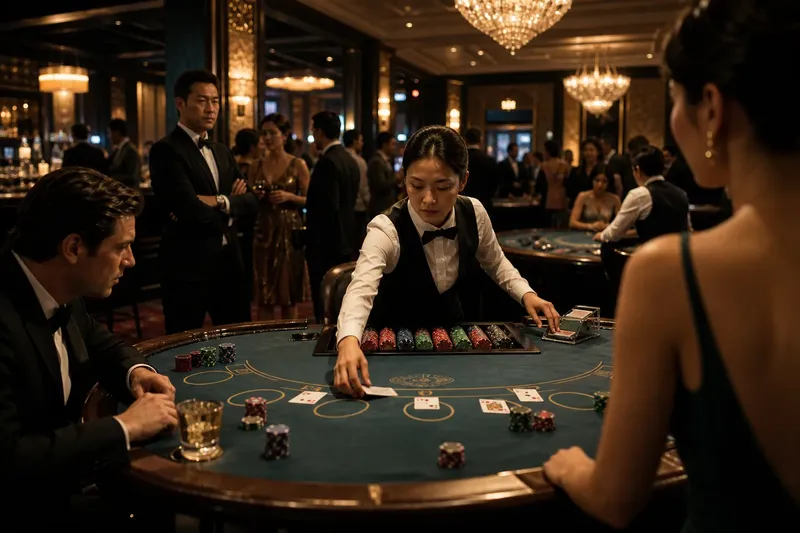
A dealer gathers scattered cards while a guest pauses at the edge of the table. In casino in popular culture, that small exchange can say more about access and attention than a sweeping shot of lights. The setting works not as a timeline of gambling’s history, but as a stage where stories arrange people, labor, and spectacle.
Who gets to belong in the room?
A private salon, a club room, or a curtained booth makes the audience notice boundaries. Who received an invitation? Who seems familiar with the room’s manners? Who watches from the doorway?
These details make a compact social drama. The game may provide the occasion, while the room reveals who has permission to speak, deal, or stay. A scene can suggest privilege without explaining its rules aloud.
Track who controls the room, and whose point of view the camera follows.
What does the public floor put on display?
A broad gaming floor places strangers, staff, and spectators in the same visual field. The story can use moving visitors and busy tables to create a sense of public entertainment. That image is a dramatic arrangement, not evidence of when a particular place became more open or popular.
Notice the watchers as well as the players. A visitor may stand close to a table without joining the game; a staff member may keep the scene moving while the camera stays fixed on a guest. The frame decides whose presence counts as atmosphere and whose counts as action.
Look at who is visible, who is working, and who remains outside the shot.
How does the room itself tell the story?
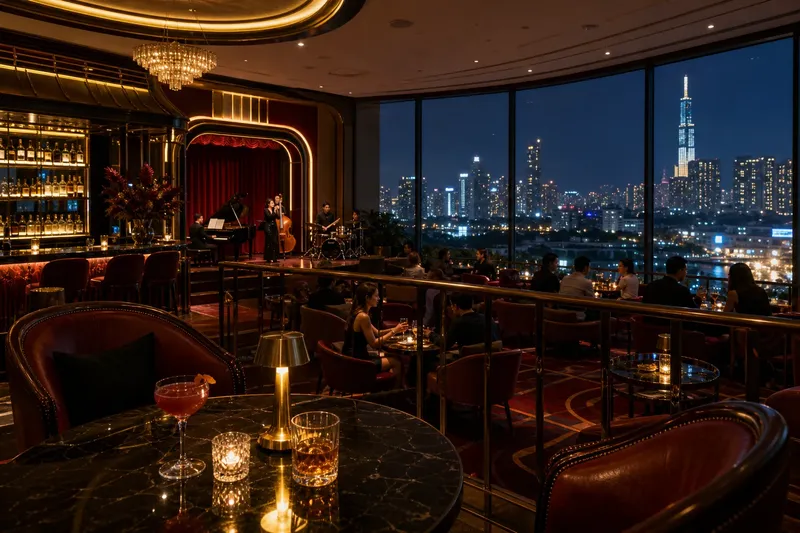
Architecture can make a threshold feel consequential. A narrow corridor suggests passage into a different social space; an open floor invites a wide view; a closed door hints at access the audience cannot share.
Lighting and layout shape that impression. A polished chandeliered room may emphasize display, while a tight view of one table can turn the setting into a contest between a few people. Neither view is a neutral map of a venue. Each leaves something out.
Compare the public signs and streams of visitors with the quiet corners, closed doors, or back-office spaces that the story chooses to show.
Why do storytellers frame the table so closely?
A table gives a scene a clear boundary. Cards, chips, dice, and a dealer’s hands let viewers follow a choice without hearing a long explanation of the game. The camera can narrow the room to a face, a gesture, or an object placed on felt.
Imagine a fictional scene in which a newcomer watches from the edge of a room, then takes a seat at a card table. The newcomer hesitates before placing a chip; a nearby regular notices, and the dealer pauses to make room. The expected effect is to turn an ordinary seating choice into a visible negotiation over confidence and belonging.
The drama comes from how the scene frames the action, not from a promise that a particular move will produce a particular result.
What can props and staff routines reveal?
Chips suggest exchange and calculation; cards conceal information; dice make a chance event visible. Costume and gesture add social cues. A practiced hand may read as confidence, while a pause can mark a character as unfamiliar with the room.
Staff routines offer another point of view. A dealer’s announcement, a card sliding across felt, or a careful reset between turns can make the venue feel organized rather than mysterious. When a story omits these repeated tasks, the game may seem to happen by itself.
Separate what the props imply from what the dialogue claims. The gap can expose how a character performs expertise.
Which details distinguish a workplace scene from a spectacle?
Casino stories often combine several modes rather than following one historical progression. A glamour scene favors entrances and polished surfaces. A workplace scene attends to coordination and repeated duties. A pressure-focused scene narrows attention to a few faces and a charged decision.
To compare two scenes, check these details and follow the decision each one supports:
- Camera distance: If the view sweeps across the room, read the scene as emphasizing spectacle; if it stays near hands and faces, consider a more intimate focus.
- Staff visibility: If dealers or attendants appear mainly as background, notice how the story centers guests; if their actions drive the sequence, read the venue as a workplace too.
- Sound: If music and crowd noise dominate, listen for a heightened public mood; if announcements and table sounds stand out, consider how routine organizes the scene.
- Access: If characters pass freely between spaces, note the impression of openness; if doors or invitations restrict movement, read belonging as a central issue.
- Props: If chips and cards receive close attention, ask how the objects make choices legible; if they remain indistinct, the scene may prioritize character or atmosphere instead.
- Background activity: If visitors and workers remain visible during the main action, include them in your reading; if the frame excludes them, treat that omission as part of the story’s emphasis.
Say you are comparing two invented scenes: one opens on guests entering a bright room as music swells, and the other stays beside a dealer resetting cards while visitors wait. The first set of observations points toward spectacle and social display; the second points toward routine work and coordination. Neither establishes a historical shift—the difference lies in what each scene asks viewers to notice.
What questions help you read casino scenes?
These questions connect familiar plot choices to the details on screen. Each answer focuses on what the scene emphasizes, rather than treating dramatic images as a record of real play.
Why do casino scenes focus on one decisive hand?
A single contest gives the story a clear point of tension and reveal. Viewers can follow a character’s choices without learning every detail of the game.
Are casino scenes meant to show realistic play?
Some aim for procedural detail, while others simplify rules to keep attention on mood or character. Treat a dramatic hand as storytelling unless the scene provides a clear reason to read it as instruction.
Why can a casino scene signal social status?
Dress, access, etiquette, and public attention can all become visible in one room. A story may use those cues to show who feels at ease and who is still trying to understand the social code.
What should you compare between two portrayals?
Compare the point of view, the spaces shown, and the work or visitors left outside the frame. Those choices indicate whether the scene emphasizes display, routine, or a small social contest.
How can you separate the scene’s message from its mythology?
A story may frame a win as destiny, instinct, or proof of unusual control because those ideas make a satisfying plot. That framing tells you how the story wants the outcome to feel; it does not make the outcome a dependable guide to real play.
Casino in popular culture becomes easier to read when you ask what the camera emphasizes and what it omits. A scene can make one table seem like the whole venue, or present a dramatic guest while leaving routine work beyond the frame.
Choose one emphasized detail and one omission. Together, they can show whether the story treats the casino as a workplace, a social boundary, or a public performance—and whose experience that portrait leaves unseen.